“Alas! This life is like a flower…” Outcry’s incomparable Describe the Night


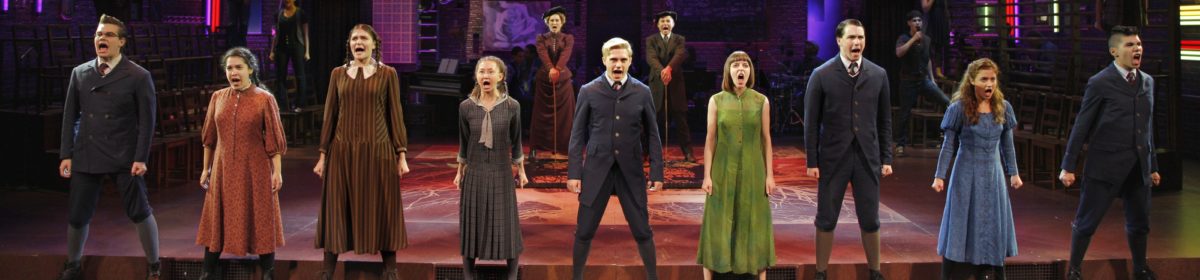
A soldier (Nikolai) out for a walk, sees an author (Isaac) writing in a notebook. He asks what it is. Isaac explains if something isn’t true, that doesn’t make it pointless. Nikolai has trouble buying this. If it’s not factual it’s a lie. They talk awhile, and become friends. So begins Describe the Night, Rajiv Joseph’s strange, audacious exploration of  language, coincidence, and the volatile nature of actuality. Mr. Joseph is a preeminent American playwright, very comfortable with grotesque, surprising narrative and ingenious composition. It’s a whirlwind. Episodes come at us quickly. Sets are practically animated! We might turn from whimsical to somber to disturbing.

Next we see a journalist (Mariya) who’s witnessed a bombing, by accident. She runs to a car rental, where she begs for a car. At first the Agent (Feliks) doesn’t grasp the urgency. But once she confides, he lends her a jalopy. In the next episode (time has passed) Nikolai invites Isaac to dinner where he introduces him to his wife (Yevgenia). Nikolai is overjoyed to see his old friend, and Isaac is too. Yevgenia and Isaac hit it off. A spark ignites. Not blazing but brilliant, just the same.

Describe the Night is set in the USSR, starting before the first revolution and well past the second, to the turn of the 20th century. It’s an ensemble piece of seven characters. Near as I can tell, there’s no multiple casting. The lives of the characters overlap. We see a character in subsequent episodes that now seems to be new, but not so. It might be age, it might be place, it might be history. Joseph may move humans as arbitrarily as God. An encounter on one occasion becomes a sea change in another. The drama doesn’t follow a straight chronological line. It hops. Even so, episodes fit, as the larger picture becomes clear.

Describe the Night is a gobsmack. You’re settled in, then another curveball bowls you over. As the story unfolds, you wonder if you can keep up. It’s not about a particular aspect of humanity, though the pieces coalesce in the sketchy nature of “truth”. The dances are jaunty and imaginative. They embody the chemistry of intersection. You think it’s a hodge-podge, a pastiche, then the full effect hits you, and incomparable shudders.

Director Becca Johnson-Spinos has orchestrated these nimble, glowy, engaged performers: Urzula (Marcy Bogner) Feliks (Chase Di lulio) Mariya (Whitney Renee’ Dodson) Nikolai (Connor McMurray) Vova (Bradford Reilly) Isaac (Dylan Weand) Yevgenia (Katelyn Yntema) with confidence and panache’.  Costumes by Katherine Wright and sets by Kennedy Smith are striking and effective. Imagine the logistics of this intriguing mosaic, with its shifts, its pulse, its presence.

This is gestalt. This is phenomenal. This is theatre electrified.

Great thanks and gratitude to Outcry who granted me permission so late in the run.

Outcry Theatre presented Describe the Night by Rajiv Joseph. It played August 23-31st, 2025, at Theatre Three’s Norma Young Arena Stage.

A Hive for the Buzzin Bees: AMOC’s HAIR


Billed as The American Tribal Love-Rock Musical, Hair was written By Gerome Ragni and James Rado with music by Galt McDermott. It premiered off-Broadway, October 17th, 1967 at Joseph Papp’s Public Theater then, Broadway on April 1968. With parallels to our present political situation, it was a protest against the Vietnam War, the Draft, oppression of Gay Rights, Women’s Rights, Black Rights. The Hippie Movement was gaining traction, pitching the Bohemian Lifestyle: polyamoros, adventurous sex, unconditional love, bliss of hallucinogenics, tolerance for alternative lifestyle, and an overall rejection of Middle-Class values.

The content inspired the structure. Such as it was/is. If shows like Godspell and Pippin featured cast members interacting with the audience and cast climbing scaffolds and perching willy-nilly onstage, for most of the show, Hair did it first. Hair embraced an unencumbered ideology. Minimal sets, nonchalant dialogue, casual attitude, childlike shenanigans. It does raise serious issues like the draft, apathy, social injustice. By and large the songs carry the heavy lifting, some of it compassionate and deeply touching, others facetious. They add gravitas and poignance to a narrative that sometimes swings wide. Hair’s salient impetus, it’s stock in trade,is jubilant, cosmic, joie de vivre’. When they encourage us to claim our destiny as bright shiners, when it wields nothing but radiance, we believe it. We believe the frissons along our spines, the nuanced rapture.

I do not envy director Brian Harden (aka Claude) who coordinated this enormous cast of raucous rapscallions. This menagerie of maniacal monkeys. Sometimes when they sing as a group it seems like small, earnest children. Caught up in the moment. Other times it’s like the ridiculous fun of drinking with friends, and you all spontaneously break into song. It just feels right.

Arts Mission Oak Cliff presents Hair: playing September 11-27th, 2025. The last three performances are Thursday-Saturday of this week, curtain at 7:30. AMOC (Arts Mission Oak Cliff) is a converted church. 410 S. Windomere, Dallas, TX, United States, Texas 75208. 469-262-0465.

Somthing like ice: Ocher House’s Opera Box

The lights come up on the living room of a family, where the mother (Stark) is bundled in a comforter. The home is comfortable, well lived in, somewhat cluttered. A bit downtrodden. There is the daughter (Hanky-Panky) the dad (JonJon) two sons (Manny and Charlie) and a daughter-in law (Ruby). Above the sofa is a window where an enormous, unsettling eye (God?) watches. The daughter comes home and talks with mom. The way she dresses is provocative. She and her mother inject heroin together. Then Manny arrives. There is tension between he and JonJon. Next Charlie and Ruby show up. They have been infected with Christian Nationalism, and Charlie has enlisted with something like ICE.

This family’s frank with one another, but not mean spirited. They have meager means, and try to roll with it, the best they can. They speak in a Shakespearean dialect: sentence structure mimics that of Shakespeare’s characters. The dialogue contrasts with class. Playwright Matthew Posey might be pointing to the dignity they bring to the world, or perhaps the suggestion that history is repeating. They are oppressed and destitute but not the outcry of frustration and rage we might ordinarily expect. They don’t squabble any more than most families. The interpersonal dynamic between them: JonJon and Ruby are playful and resigned, Hanky Panky and Mom get on, despite Mom’s lack of tact.

The tone of Opera Box is like Salvador Dali, the grotesque and puzzling taken as a given. Beneath the layer of the familiar and bizarre there deep despondency. Like Waiting For Godot the comical and dry lyricism are informed by disappointment and despair. It permeates. While Vladimir and Estragon wait incessantly for the foretold arrival, this family isn’t searching for answers. I don’t believe they are disingenuous, circumstances are closing in, but fighting gradual destruction feels pointless. When Charlie and Ruby declare the salvation they’ve found, they read as ridiculous, pathetic.

The enigmatic aspects of Opera Box are unsettling and sharp. The eye that appears with its freakish curiosity might be God, casually observing with no desire to intervene. Possibly it’s the privileged class, the characters in this tragedy acting out and singing deeper emotions for their entertainment. Sometimes characters appear in that same window, looking ghoulish and portentous. The son with the head the size of an elephant. The cyclone that Ruby cooks up in a dance of religious ecstasy.

Opera Box is low key. Consider lying on the beach, paralyzed, while the tide washes and creeps, until you drown. What Hannah Arendt called the banality of evil. Vindictiveness concealed by apathy. The wealthy ruining lives because they can. The buffoon that runs amok because no one will stop him. Matthew Posey’s nearly whispered allegory is delicate and terrifying. Something or someone is waiting to eat you alive.

The Ochre House presents Opera Box, playing September 3-September 20th, 2025. ASL Interpretation: Saturday, September 13th. 825 Exposition, Dallas, Texas. 214-826-6273. ochrehousetheater.org