
Solange and Claire are sisters who live in the garret of an aristocratic woman, addressed only as “Madame”. On this particular evening the Madame is out, her boyfriend in jail and Claire and Solange left to their own devices. They’re involved in role play. Claire playing the part of their Mistress, and Solange herself, serving and indulging. Claire puts her in one of Madame’s sumptuous dresses, a gesture of noblesse oblige. Her behavior a mix of gratitude and subtle arrogance. Even when Madame’s abusive Solange is compliant. Then they switch places. Even in the thick of it, they keep an eye on the clock.
Madame arrives unexpectedly, light, without a care. She’s more gamine than Claire (if that’s possible) flouncy, but sweet. Her white clothes startling in comparison to Claire and Solange’s uniforms (black dresses, white aprons, slight frills) and the lush crimson comforter. The contradiction striking between the Madame’s behavior, and each sister’s version of misuse. Is their perception accurate, or an ache for exploitation? When Patricia asks Michel (in Godard’s Breathless) if he would rather be abused or ignored, he replies: Who would want to be abused?
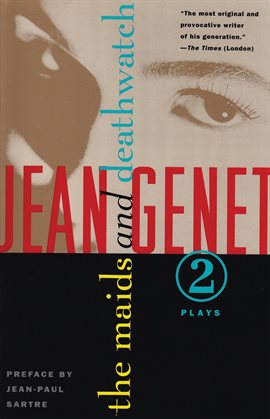
It’s no surprise Jean Genet lived by this sad truth. No worse torture than virtual invisibility. Deliberately trivialized. Even if you’re made to grovel, mocked, battered, or humiliated, at least you’re acknowledged. On some level, you matter. Genet’s The Maids was his take on Lea and Christine, The Papin sisters, who murdered their mistress and her grown daughter, on February 2nd, 1933, in Le Mans, France. The two were subjected to degradation, paid next to nothing, subsisting on paltry provisions, despite their wealthy employers. Great intellectuals of that time: Jean-Paul Sartre, Simone de Beauvoir, Jacque Lacan (and certainly Genet) took up their cause, citing their circumstances as a quintessential case of class struggle. Numerous artistic explorations emerged: plays, films, a documentary and spoken word.
Sartre himself lived a life of destitution, surviving by thievery. When he was thrown in prison, he was subjected to successive, violent, sexual abuse. In time, after his release, he became one of the world’s great authors. He found a way to resolve abject misery in dedication to craft. Some kind of compassion and beauty in the grotesque. His surreal, stylized slant on atrocity, driven by the need to salvage his spirit.
The Maids achieves staggering, devastating, disturbing, theatre. It doesn’t roar like a tiger, it waits like a snake. The air seems suffused with lavender and opium. There’s a pervasive sense of the malignant, the decayed. There’s a fire consuming the chateau and they’re ignoring it. Or they can’t notice. They create a devious actuality, a sinister gentility. The women seem intoxicated by the rough hum of bumble bees, the hushed gnawing of vermin. You can’t take your eyes off them. The drowsy flowers of Genet’s dialogue drop from their tongues, these diaphanous, priestesses of chaos.
This Classics Theatre Project’s production of The Maids is beyond subversive. Beyond expectations. It’s a once-in-a lifetime experience.
The Classics Theatre Project presents Jean Genet’s The Maids, playing February 6th-March 8th, 2026. Stone Cottage (adjacent to Addison Water Tower Theatre) 15650 Addison Rd. Addison, TX 75001. (214) 923-3619. tctpdfw@gmail.com. theclassicstheatreproject.com