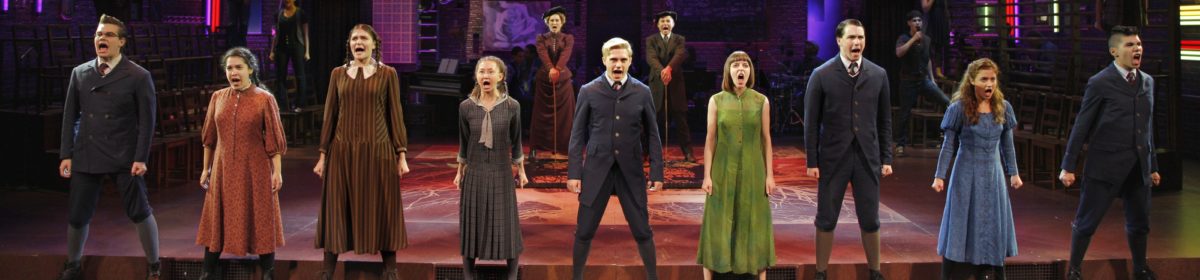
Fifth light means end of the world: Undermain’s Skin of our Teeth

We join the Antrobus family at the beginning of three catastrophes. The Ice Age, The Great Flood, and World War II. The quintessential nuclear family, each member an archetype. Sabina, the maid, is the conniving, seductive siren. Henry is Cain, the wounded, homicidal delinquent. Gladys the spirited, adventurous daughter. Maggie the fierce, pragmatic mother, protecting the nest. The mainstay of civilization. George the dad, is raucous, pompous, and goodhearted. He has true genius, a spark that nudges humanity forward. The alphabet, the wheel, mathematics. His accomplishments stand with Newton, Einstein, Gutenberg. It’s not simply discovery, but when and how these occur in history.

Playwright Thornton Wilder has assembled a montage. Scraps and torn pieces from experiences of the every day. It might be a ticket to the movies, a parking citation, a foreclosure, a phone bill, a lab result. Despite the disparate nature of purpose and paper, he finds a way to make them fit. To make them work. The result far beyond the sum of its parts. Wilder has made a gloss of the human experience. Over centuries, over tragedies, over warfare, over celebration.

He constructs a home where the Antrobus family struggles to subsist. Chaos besieges from without and within. During the Ice Age they fight worse cold than anyone’s ever known. Sabina’s more concerned with nuisance than keeping the crucial fire going. Henry’s in dark trouble at school. Maggie makes impossible decisions because she must. George offers refuge to transients, when they barely have enough to live on, themselves.

Wilder ignores the fourth wall. We are subject to the extremes of survival. Sandwiches are passed around (Yum!). The show pauses to replace cast members. The fortune teller and Sabina address us directly. He crisscrosses details from different times. Anachronistic turning points are referenced. The Great Flood arrives at the Boardwalk. In contrast to her husband, Maggie discovers nylon stockings and the silkworm. Her inventions less lofty but useful in the day to day.

The Skin Our Teeth assembles the universe (deliriously and fancifully) within the confines of the Antrobus home and the Undermain Stage. It’s a curious allegory mixing the outlandish with the despondent. You might call it: Surviving the Unthinkable. Miseries considered only in the abstract till unavoidable. George, Maggie, Henry and Gladys are flawed but also heroic, just the rest of us. Fractured and lost and vain though we may be.

One imagines director Stefan Novinski spinning plates on sticks like jugglers back in the day. Too many simultaneous elements to follow, but thanks to Novinski, they converge. Narration from a newsreel, a model of the Antrobus home, cardboard houses encircling the perimeter, a reporters desk, puppets, a succession of performers quoting great philosophers. Actors play their parts but also, the “role” of themselves. Wilder sews the thread that proves out humanity. Humanity is the connective tissue. The actors are versatile and focused, shifting between moods and situations, with equal panache. They tuck into disparate characters with fervor.

Undermain Theatre presents: The Skin of our Teeth playing February 14th -March 8th, 2026.

3200 Main Street, Dallas, Texas. Tickets at Undermain.org. 214-747-5515/

Back in the Day: Undermain’s The Skin of our Teeth


We join the Antrobus family in the midst of three catastrophes. The Ice Age, Great Flood, and World War II. They are the quintessential nuclear family, each member an archetype for the ages. Sabina, the maid, is the conniving, seductive siren. Henry is Cain, the wounded, homicidal delinquent. Gladys is the spirited, adventurous daughter. Maggie is the fierce, pragmatic mother, determined to protect her nest, the mainstay of civilization. George the dad, is raucous, pompous, goodhearted and subject to Sabina’s spell. George has true genius, the spark that nudges humanity toward evolution. The alphabet, the wheel, mathematics. His accomplishments stand with Newton, Einstein, Guttenberg. Not simply discovery, but how they impact history.

Playwright Thornton Wilder has assembled a montage. Scraps and torn pieces from the experience of the every day. It might be a ticket to the movies, a parking citation, a foreclosure, a phone bill, a lab result. Despite their disparate nature, he finds a way to make them fit. To make them work. The result is far beyond the sum of its parts. Wilder has created a gloss of human experience. Over centuries, over tragedies, over warfare, over celebration.

He creates a context where the Antrobus family dwells, and struggles to subsist. Chaos besieges from forces from without and within. During the ice age they must fight horrendous, unbelievable cold. Worse than they’ve ever seen. Sabina is more concerned with petty tribulations than keeping the crucial fire lit. Henry is in dark trouble at school. Maggie makes impossible decisions because she must. George offers refuge to starving refugees when they barely have enough to live on, themselves.

The Skin of Our Teeth ignores the fourth wall. He includes us in the extremes of survival. Sandwiches are passed. The show stops to replace members of the cast. The fortune teller and Sabina address us directly. He crisscrosses details from different times. The Great Flood arrives at the Boardwalk. Anachronistic turning points are referenced in each act.  In contrast to her husband, Maggie discovers nylon stockings and the silkworm. Her inventions are less lofty but more useful in the day to day.

The Skin Our Teeth assembles the universe (with delirious and imaginative surprises) within the confines of the Antrobus home and the Undermain Stage. It’s a curious allegory mixing the outlandish with the interpersonal. You might call it a Handbook for Surviving the Unthinkable. Miseries we only consider in the abstract, until they’re unavoidable. George, Maggie, Henry and Gladys are terribly flawed and also heroic, just like the rest of us. And just like us, fractured and lost and vain though we may be, we deserve to thrive.

One imagines director Stefan Novinski spinning plates on sticks like jugglers from back in the day. So many simultaneous elements to keep track of, but thanks to Novinski, they converge. Narration by newsreel, a model of the Antrobus home, cardboard houses encircling the perimeter, a reporters desk, puppets, a succession of performers quoting the great philosophers. We see the actors playing their parts but also, in the “role” of themselves. Wilder sews the thread as witness to humanity. Humanity is the connective tissue. The actors here are versatile and focused, shifting between mood and situation, with equal panache. They tuck into their characters with furvor.

Undermain Theatre presents: The Skin of our Teeth playing February 14th -March 8th, 2026. 3200 Main Street, Dallas, Texas. Tickets at Undermain.org. 214-747-5515

The future is now: Undermain’s The Skin of our Teeth


We join the Antrobus family in the midst of three catastrophes. The Ice Age, Great Flood, and World War II. They are the quintessential nuclear family, each member an archetype for the ages. Sabina, the maid, is the conniving, seductive siren. Henry is Cain, the wounded, homicidal delinquent. Gladys is the spirited, adventurous daughter. Maggie is the fierce, pragmatic mother, determined to protect her nest, the mainstay of civilization. George the dad, is raucous, pompous, goodhearted and subject to Sabina’s spell. George has true genius, the spark that nudges humanity toward evolution. The alphabet, the wheel, mathematics. His accomplishments stand with Newton, Einstein, Guttenberg. Not simply discovery, but how they impact history.

Playwright Thornton Wilder has assembled a montage. Scraps and torn pieces from the experience of the every day. It might be a ticket to the movies, a parking citation, a foreclosure, a phone bill, a lab result. Despite their disparate nature, he finds a way to make them fit. To make them work. The result is far beyond the sum of its parts. Wilder has created a gloss of human experience. Over centuries, over tragedies, over warfare, over celebration.

He creates a context where the Antrobus family dwells, and struggles to subsist. Chaos besieges from forces from without and within. During the ice age they must fight horrendous, unbelievable cold. Worse than they’ve ever seen. Sabina is more concerned with petty tribulations than keeping the crucial fire lit. Henry is in dark trouble at school. Maggie makes impossible decisions because she must. George offers refuge to starving refugees when they barely have enough to live on, themselves.

The Skin of Our Teeth ignores the fourth wall. He includes us in the extremes of survival. Sandwiches are passed. The show stops to replace members of the cast. The fortune teller and Sabina address us directly. He crisscrosses details from different times. The Great Flood arrives at the Boardwalk. Anachronistic turning points are referenced in each act.  In contrast to her husband, Maggie discovers nylon stockings and the silkworm. Her inventions are less lofty but more useful in the day to day.

The Skin Our Teeth assembles the universe (with delirious and imaginative surprises) within the confines of the Antrobus home and the Undermain Stage. It’s a curious allegory mixing the outlandish with the interpersonal. You might call it a Handbook for Surviving the Unthinkable. Miseries we only consider in the abstract, until they’re unavoidable. George, Maggie, Henry and Gladys are terribly flawed and also heroic, just like the rest of us. And just like us, fractured and lost and vain though we may be, we deserve to thrive.

One imagines director Stefan Novinski spinning plates on sticks like jugglers from back in the day. So many simultaneous elements to keep track of, but thanks to Novinski, they converge. Narration by newsreel, a model of the Antrobus home, cardboard houses encircling the perimeter, a reporters desk, puppets, a succession of performers quoting the great philosophers. We see the actors playing their parts but also, in the “role” of themselves. Wilder sews the thread as witness to humanity. Humanity is the connective tissue. The actors here are versatile and focused, shifting between mood and situation, with equal panache. They tuck into their characters with furvor.

Undermain Theatre presents: The Skin of our Teeth playing February 14th -March 8th, 2026. 3200 Main Street, Dallas, Texas. Tickets at Undermain.org. 214-747-5515

Strychnine Cocktail: Classics Theatre Project’s The Maids

Solange and Claire are sisters who live in the garret of an aristocratic woman, addressed only as “Madame”. On this particular evening the Madame is out, her boyfriend in jail and Claire and Solange left to their own devices. They’re involved in role play. Claire playing the part of their Mistress, and Solange herself, serving and indulging. Claire puts her in one of Madame’s sumptuous dresses, a gesture of noblesse oblige. Her behavior a mix of gratitude and subtle arrogance. Even when Madame’s abusive Solange is compliant. Then they switch places. Even in the thick of it, they keep an eye on the clock.

Madame arrives unexpectedly, light, without a care. She’s more gamine than Claire (if that’s possible) flouncy, but sweet. Her white clothes startling in comparison to Claire and Solange’s uniforms (black dresses, white aprons, slight frills) and the lush crimson comforter. The contradiction striking between the Madame’s behavior, and each sister’s version of misuse. Is their perception accurate, or an ache for exploitation? When Patricia asks Michel (in Godard’s Breathless) if he would rather be abused or ignored, he replies: Who would want to be abused?

It’s no surprise Jean Genet lived by this sad truth.  No worse torture than virtual invisibility.  Deliberately trivialized. Even if you’re made to grovel, mocked, battered, or humiliated, at least you’re acknowledged. On some level, you matter. Genet’s The Maids was his take on Lea and Christine, The Papin sisters, who murdered their mistress and her grown daughter, on February 2nd, 1933, in Le Mans, France. The two were subjected to degradation, paid next to nothing, subsisting on paltry provisions, despite their wealthy employers. Great intellectuals of that time: Jean-Paul Sartre, Simone de Beauvoir, Jacque Lacan (and certainly Genet) took up their cause, citing their circumstances as a quintessential case of class struggle. Numerous artistic explorations emerged: plays, films, a documentary and spoken word.

Sartre himself lived a life of destitution, surviving by thievery. When he was thrown in prison, he was subjected to successive, violent, sexual abuse. In time, after his release, he became one of the world’s great authors. He found a way to resolve abject misery in dedication to craft. Some kind of compassion and beauty in the grotesque. His surreal, stylized slant on atrocity, driven by the need to salvage his spirit.

The Maids achieves staggering, devastating, disturbing, theatre. It doesn’t roar like a tiger, it waits like a snake. The air seems suffused with lavender and opium. There’s a pervasive sense of the malignant, the decayed. There’s a fire consuming the chateau and they’re ignoring it. Or they can’t notice. They create a devious actuality, a sinister gentility. The women seem intoxicated by the rough hum of bumble bees, the hushed gnawing of vermin. You can’t take your eyes off them. The drowsy flowers of Genet’s dialogue drop from their tongues, these diaphanous, priestesses of chaos.

This Classics Theatre Project’s production of The Maids is beyond subversive. Beyond expectations. It’s a once-in-a lifetime experience.

The Classics Theatre Project presents Jean Genet’s The Maids, playing February 6th-March 8th, 2026. Stone Cottage (adjacent to Addison Water Tower Theatre) 15650 Addison Rd. Addison, TX 75001. (214) 923-3619. tctpdfw@gmail.com. theclassicstheatreproject.com

Unbroken Circle: Firehouse’s Ring of Fire: The Music of Johnny Cash

Saturday, January 31st, I saw Firehouse Theatre’s Ring of Fire: The Music of Johnny Cash. I’ve been attending musicals at Firehouse for a very, very long time, and (hand to God) I’ve never once been disappointed. Not once. The sets, performers, costumes, were always impeccable. The actors lively and authentic, the stories absorbing and songs memorable. So, naturally, my expectations last Saturday night were high.

Ring of Fire details the life of Johnny Cash, preeminent country singer, master of heartbreak, romance and devotion. Each song ties in handily with the convivial and somber times of his life: devastating flood, loss of his brother Jack, auditioning for a studio, his first connection with bride to be. Vivid imagery nails the situation just right. I ain’t seen the sunshine. I walk the line. I jumped in to a burning ring. The lyric and melody are deeply touching, raucous and chipper, soulful and filled with faith. I have always admired the frank, steady, poignant stories of country music. It’s not easy to do well. To communicate the impact of God in our lives. The hope of seeing our loved ones who have gone before. The confidence that even through the inexplicable, that God has our back. Knowing that He cares.

We explore Johnny Cash’s empathy for the lost souls of Folsom Prison, his declaration of fidelity to June Carter, sweet and joyful times around the kitchen table. Each episode adds another piece to the story. The cast (Ben Meaders, Gideon Ethridge, Nathan Benson, Bryson Morlan, Audrey Reidling) is confident, versatile, with sunshine to spare. The double and triple casting must be quite a workout. Their heads are definitely in the game. The spirited music is contagious. It pulls you right in, and gets you hooked. In the best possible way. We’re helpless to enjoy and embrace those warm, human moments.

Mr. Benson. It seems I was sitting right in front of your folks. They said they had no idea you played the horn.

Get your tickets now for Ring of Fire: A heartfelt, boisterous, inspiring evening of jubilation!

Firehouse Theatre Presents: Ring of Fire: The Music of Johnny Cash. Playing January 30th, February 15th, 2026. 2535 Valley View Lane, Farmers Branch, TX, United States, 75234. thefirehousetheatre.com. (972) 620-3747

Come on out, Boo: The Core’s impeccable, deeply moving To Kill A Mockingbird

In 1960 Harper Lee published the groundbreaking novel: To Kill a Mockingbird, a startling, unabashedly frank exploration of race relations, gender identity, ignorance and poverty. It exposed the ugly, sad, brutality of fear and resentment, without being didactic. Set in 1930, in the fictional town of Maycomb, Alabama, Mockingbird details a crime: Tom Robinson is accused of raping Mayella Ewell. The town is in upheaval. Some want to lynch him, some hold with their better angels.

The narrative turns on Attorney Atticus Finch and his children, Scout and Jem. Finch has been assigned to defend Robinson, undeniably the best man for the job. Scout, as a grown woman, describes their life; the neighbors and odd ducks, the friendly and petulant. As incidents transpire, we get the drift of attitudes and values of the community. The cranky dowager with the nice garden, the farmer who must pay Atticus by barter, Tom Robinson’s wife sitting in the segregated section of the courtroom, Mayella watching her father as she testifies. Harper Lee takes us through the intersections between the different classes. She does so without pity or disparagement. Each character (flawed as they may be) is treated with dignity and respect. Never quaint.

Director James Prince has a genius for performance and presentation. In the first act we see five doors to five homes, making a circle. The acting space is surrounded by thresholds to different families and we, the audience might be another household, completing the circle. There’s something tribal, perhaps, something enigmatic about this layout. It emphasizes our participation the story. An equanimity between us and the townspeople. In the second act, the courtroom encircles the stage, again pulling us into the spectacle and action. Are we bearing witness to a ritual, an evocation of the painful truths so often buried under affectation and complicity?

Mr. Prince navigates this versatile, dedicated cast of nineteen (that’s right!?) with kinetic wisdom and rhythmic poise. Each character has their particular demeanor, their own energy: clicking like a cricket or sputtering like a jalopy or sailing like a sloop. Prince orchestrates with precision and grace. Each performer keeps their head in the game, focused and motivated.Kudos to James Prince for his inspired and masterful direction.

Over time, I have seen numerous productions at The Core ( Inferno, Our Town, Our Town, Wait Until Dark..) and never once I have been disappointed. Their slant on dramas familiar and exotic is always intriguing, insightful,and entertaining. The players are spirited, the energy pops and the interpretations sublime. Don’t miss this opportunity to catch To Kill a Mockingbird at The Core in Richardson

The Core presents Harper Lee’s To Kill A Mockingbird, playing January 26th, 2026. 518 West Arapaho Road, Suite 115, Richardson, Texas 75080. thecoretheatre.org (214) 930-5338

Jingle all the way: RTC’S Third Annual Holiday Radio Show

For the third year, Richardson Theatre Centre has staged their holiday radio play. By now an industry standard, a radio play reveals the actors as they broadcast: zany skits, carols sung with gusto or melancholy, by choir, duet and solo. (Songs are meticulous, harmonious, with flawless phrasing. Not a klinker among them.) And certainly, the Emcee, with his perpetual line of shtick, and groan worthy gags. The formidable ensemble consists of twelve different players, cross cast in sketches and musical numbers. WRTC’s Holiday Show gives us a feel for the cast, behind the scenes. We catch a glimpse of the characters when the ON THE AIR sign is given a break.

Since this particular iteration is set during World War 2, the show is dedicated to the soldiers overseas. Slides and letters to and from home, equal parts comic and wistful. There’s also a fizzy energy: cast and crew jazzed and eager. Contagious as the cocktail flu. These merrymakers are versatile and limber, shifting gears and wielding banter with precision. There’s the brusque gumshoe and congenial, ditzy lady. There’s the squabbling couple and litany of commercials, so characteristic of a time, when everybody got their news and relief from movies or films, or the radio. The flavor and creativity of entertainers like George Burns and Gracie Allen, The Shadow, Orson Welles, Hedda Hopper… and of course, the striving but no less spectacular artists, are so different from today.

Now for the Third Christmas, Richardson Theatre Center has presented this bright, nonsensical, vivid revue, suffused with sincerity and delight. They capture the essence of Christmas spirit, avoiding tropes and putting a fresh slant on the season. The audience is convivial, stoked for this eccentric, buoyant channel of enchantment and humanity. Nothing wrong with A Christmas Carol, The Best Christmas Pageant Ever, White Christmas, Holiday Inn, but thanks to RTC, there’s room for fresh material.

From December 5th-21st, 2025, Richardson Theatre Center featured their Annual Holiday Radio Show (with hearty thanks to Rusty Harding). 518 West Arapaho Road, Suite 113, Richardson, Texas 75080. 972-699-1130. richardsontheatrecentre.net

Jingle all the way: RTC’s 3rd Annual Holiday Radio Show

For the third year, Richardson Theatre Centre has staged their holiday radio play. By now an industry standard, a radio play reveals the actors as they broadcast: zany skits, carols sung with gusto or melancholy, by choir, duet and solo. (Songs are meticulous, harmonious, with flawless phrasing. Not a klinker among them.) And certainly, the Emcee, with his perpetual line of shtick, and groan worthy gags. The formidable ensemble consists of twelve different players, cross cast in sketches and musical numbers. WRTC’s Holiday Show gives us a feel for the cast, behind the scenes. We catch a glimpse of the characters when the ON THE AIR sign is given a break.

Since this particular iteration is set during World War 2, the show is dedicated to the soldiers overseas. Slides and letters to and from home, equal parts comic and wistful. There’s also a fizzy energy: cast and crew jazzed and eager. Contagious as the cocktail flu. These merrymakers are versatile and limber, shifting gears and wielding banter with precision. There’s the brusque gumshoe and congenial, ditzy lady. There’s the squabbling couple and litany of commercials, so characteristic of a time, when everybody got their news and relief from movies or films, or the radio. The flavor and creativity of entertainers like George Burns and Gracie Allen, The Shadow, Orson Welles, Hedda Hopper… and of course, the striving but no less spectacular artists, are so different from today.

Now for the Third Christmas, Richardson Theatre Center has presented this bright, nonsensical, vivid revue, suffused with sincerity and delight. They capture the essence of Christmas spirit, avoiding tropes and putting a fresh slant on the season. The audience is convivial, stoked for this eccentric, buoyant channel of enchantment and humanity. Nothing wrong with A Christmas Carol, The Best Christmas Pageant Ever, White Christmas, Holiday Inn, but thanks to RTC, there’s room for fresh material.

From December 5th-21st, 2025, Richardson Theatre Center featured their Annual Holiday Radio Show (with hearty thanks to Rusty Harding). 518 West Arapaho Road, Suite 113, Richardson, Texas 75080. 972-699-1130. richardsontheatrecentre.net

You put a spell on me: ACT’S 25th Annual Putnam County Spelling Bee

Like any customary competition, The Spelling Bee, has it’s rules and rituals. Could you please use the word in a sentence? Could you pronounce it? The finalists (Leaf, Olive, Logainne, Barfee’, Chip) ask Vice Principle Panch, perhaps stalling. Miss Peretti (organizer and host of “The Bee”) completes the group.

The kids are awash in peccadillos, foibles, and their path to success, strange or daunting. Leaf channels some demon who coincidentally, is a master speller. Olive must deal with stage fright and feuding dads, Barfee’ uses a kind of foot calligraphy and Chip is subjected to an unfortunate erection. First they’re mocked, then they’re lionized.

A pastiche of chaos, dejection and absurd, irreverent humor: The 25th Annual Putnam County Spelling Bee takes earnestness and invites us to laugh with, not at. Why does anybody care about a spelling bee? How can this work for a musical comedy? Relegated to the (non-athletic) land of the marginalized and ridiculous, the characters must take themselves seriously. And by the closing song, we understand why.

It’s easy to mistake clownishness for disparagement, but humanity comes through. We are (despite endless digression and flashbacks) actually touched by their bad luck and predicaments. The same things that tickle us. We wonder if it’s critique, or keen reflection of any enterprise. Choosing to make the best of what might be amazing. On this hangs the key irony.

Kudos to Director Eddy Herring for his deft orchestration of this versatile, intrepid cast. This loony, dizzy script. They never miss a cue, or fail to take advantage of any opportunity to trigger helpless laughter. The best kind. They find the tenuous line between pathos and pity. They turn on a dime. The band weaves musical numbers seamlessly. Laura Alley’s whimsical costumes are a perfect fit for the playfful mood.

Allen Contemporary Theatre ran 25th Annual Putnam County Spelling Bee from December 5th-21st, 2025. 1210 E Main Street, #300, Allen, TX, United States, Texas. (844) 822-8849. allencontemporarytheatre.net

The sacred and the grotesque: Undermain’s dolorous, enigmatic Action.

Shooter, Lupe, Liza and Jeep are having Christmas Dinner. They set dishes on a card table. Napkins but no flatware. Water comes from a well. They eat with their fingers. No vegetables or bread. Before Lupe brings out the beautifully browned turkey, Jeep is telling an anecdote about a dancing bear. Shooter pulls his sweater way over his head, making paws of his hands, enacting the story.

Jeep then talks about the poet: Walt Whitman. Overcome with empathy and tenderness, Whitman nursed civil war soldiers, among the disarticulated limbs and carnage. Intersection of the grotesque and sacred. Jeep has a rather short fuse. He splinters chairs in these moments. Eventually Lupe must remind him when they’re down to the last chair. Jeep discloses a monologue, while he washes his hands, over and over. They never get clean.

There’s something vaguely rhetorical, searching, in their dialogue. You can buy a cow for twenty-five bucks, but nobody who’s selling. They have only one book, and compulsively search for a passage they never find. Liza might be the Scholar. She’s rigid about propriety, and sometimes breaks out in rage. Jeep, I think is the Artist, speaking sublimely about the day he’ll become himself in actuality. His voice almost shines. Lupe, the Hearth Keeper, is very calm. She takes things in hand.  The childlike Shooter is the Laborer. Like the four astronauts we sometimes discuss in the abstract, they might be chosen to habitate a better planet. They all make their contribution.

The four assemble a family. Yearning to salvage sympathy, reasoning, the refined. They respect these ideals. Honor them. There are outbreaks of frustration, anger, destitution. There’s chaos and mess and groping and the ridiculous. But once we see their predicament (for a lack of a better word) we get the contained desperation. This square table, north, south, east and west, where meals are shared, participants engage and converse. Where they try to preserve the privilege of humanity. It might be the only place left, where recovery begins and ends.

Director Christina Cranshaw arranges the performers with skill and intuition. The rhythms of silence and tension, ticking and breakdown and exhaustion fall into place. Effective but unnerving. Taylor Harris (Shooter) a grand, tall, formidable guy, manages with humor and a kind of pathos. Caleb Mosley (Jeep) has that verve of the touchy creator, busy with energy and fascination. Sienna Castaneda Abbott (Lupe) in her eye-catching, festive holiday apron, is the rod that contains the lightning. Mikaela Baker (Liza) seems testy at times. She’s searching for higher truth, but knows you can’t have order without rules.

The Undermain launches their 42nd Season, with Action, by Sam Shepard, one of America’s preeminent playwrights (may God speed). Doubtlessly and sadly relevant to the present world and life we endure, Action is a marvel of bedlam, tragedy, and characters feverish with longing. They creep into your head, and know just where you live. They slyly wield the shock of recognition.

Undermain Theatre presents Sam Shepard’s Action, playing November 6th-December 7th, 2025. 3200 Main Street, Dallas, Texas 75223. 214-747-5515. Undermain.org