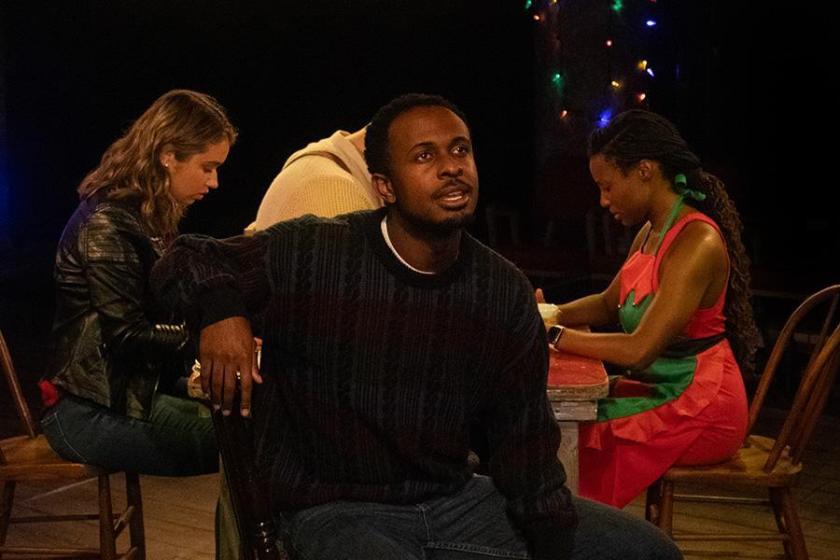
Mom and Dad are fighting: TCTP’s Who’s Afraid of Virginia Woolf?

On October 13th, 1962, Edward Albee’s Who’s Afraid of Virginia Woolf? premiered at The Billy Rose Theater on Broadway. It starred Arthur Hill as George, Uta Hagen as Martha, George Grizzard as Nick, and Melinda Dillon as Honey. In 1963, it won the Tony and New York Critic’s Circle for Best Play. It was selected for the 1963 Pulitzer Prize, by the drama jury. But the advisory board objected to its profanity and sexual themes, awarding no Pulitzer Prize for drama in 1963.

So began the notorious history of Who’s Afraid of Virginia Woolf?, a watershed that changed how people thought about drama. Otherwise considered an Absurdist, Who’s Afraid might be the closest Albee ever came to recognizable narrative. We can’t be sure how many middle-aged couples invite company to witness their brutality. Liberal use of liquor can lead to sketchy behavior. That being said,  Albee was a brilliant iconoclast.

Who’s Afraid finds George and Martha returning from a faculty party around midnight. George teaches History, and Martha’s the daughter of the University President. Martha is more than tipsy and George finds her rowdy, scattered and childish behavior annoying. But she brushes him off. She announces she’s invited a younger couple over for a drink. When they arrive, Nick and Honey introduce themselves. Nick is in the Biology department, and Honey, his devoted wife. Martha turns on a dime and makes for an affable hostess. Though these two are as baffled as George at the midnight invitation.

From the start, Nick and Honey can tell something’s off. George and Martha progressively move from good-natured jabs to squabbling to vindictiveness to verbal brawling, and keeps escalating. When they’re not trading blows, George attacks the other couple, passively going for the jugular. We’ve got to wonder if George and Martha are hosting because they crave an audience. Nick and Honey keep trying to leave, but the older couple insists they stay. Though, strangely enough, no one’s actually preventing them. Whether or not they’re in the same room, George and Martha are constantly finding  some way to get the other.

Albee keeps everything off-balance, taking aim at cultural stereotypes. Both couples have no children, and nothing to suggest they will. While George and Martha are always bickering, Nick and Honey (for all their niceties) don’t seem to like each other. Like Eugene O’Neill, Albee uses alcohol as a lie detector. George and Martha keep imbibing, while handing fresh drinks to the guests. As the evening commences, vulnerabilities emerge, and the older couple’s exchanges get more vicious. Albee observes (with contempt and cynicism) that America’s model for sublime matrimony is a sham; with expectations no one can manage. The wife is a harridan or insipid. The husband a stud or a houseboy.

You cannot help but stand in awe of The Classics Theatre Project, for taking on such an intense, unmerciful piece as Who’s Afraid of Virginia Woolf? They may be one of the few with the chops for it. Three acts, two intermissions, while we watch George and Martha eat each other alive. It is genuinely shocking. The cast leaves artifice far, far behind for the sake of authenticity.

Terry Martin gives George a steady, intelligent dignity. Quiet but sentient. John Cameron Potts makes an interesting Nick. He swings between a smile and a sneer, relaxed and polite. Devon Rose gives Honey an animated turn. Not only comic relief, her despondence and hurt are poignant. As Martha, Diane Box-Worman is the raw, raucous, deprecating core of the play. She ticks, ticks, ticks till her anger shakes us to pieces. She is fearless, broken humanity (without apology or affectation). Surrendering to destruction and grief. I don’t believe I’ve ever seen anything like it.

The Classics Theatre Project presents Who’s Afraid of Virginia Woolf? Playing October 3rd-24th, 2025. Stone Cottage Theatre, 15650 Addison Road, Addison Texas, 75001. 214) 923 3619. ctpdfw@gmail.comtheclassicstheatreproject.com

“Alas! This life is like a flower…” Outcry’s incomparable Describe the Night


A soldier (Nikolai) out for a walk, sees an author (Isaac) writing in a notebook. He asks what it is. Isaac explains if something isn’t true, that doesn’t make it pointless. Nikolai has trouble buying this. If it’s not factual it’s a lie. They talk awhile, and become friends. So begins Describe the Night, Rajiv Joseph’s strange, audacious exploration of  language, coincidence, and the volatile nature of actuality. Mr. Joseph is a preeminent American playwright, very comfortable with grotesque, surprising narrative and ingenious composition. It’s a whirlwind. Episodes come at us quickly. Sets are practically animated! We might turn from whimsical to somber to disturbing.

Next we see a journalist (Mariya) who’s witnessed a bombing, by accident. She runs to a car rental, where she begs for a car. At first the Agent (Feliks) doesn’t grasp the urgency. But once she confides, he lends her a jalopy. In the next episode (time has passed) Nikolai invites Isaac to dinner where he introduces him to his wife (Yevgenia). Nikolai is overjoyed to see his old friend, and Isaac is too. Yevgenia and Isaac hit it off. A spark ignites. Not blazing but brilliant, just the same.

Describe the Night is set in the USSR, starting before the first revolution and well past the second, to the turn of the 20th century. It’s an ensemble piece of seven characters. Near as I can tell, there’s no multiple casting. The lives of the characters overlap. We see a character in subsequent episodes that now seems to be new, but not so. It might be age, it might be place, it might be history. Joseph may move humans as arbitrarily as God. An encounter on one occasion becomes a sea change in another. The drama doesn’t follow a straight chronological line. It hops. Even so, episodes fit, as the larger picture becomes clear.

Describe the Night is a gobsmack. You’re settled in, then another curveball bowls you over. As the story unfolds, you wonder if you can keep up. It’s not about a particular aspect of humanity, though the pieces coalesce in the sketchy nature of “truth”. The dances are jaunty and imaginative. They embody the chemistry of intersection. You think it’s a hodge-podge, a pastiche, then the full effect hits you, and incomparable shudders.

Director Becca Johnson-Spinos has orchestrated these nimble, glowy, engaged performers: Urzula (Marcy Bogner) Feliks (Chase Di lulio) Mariya (Whitney Renee’ Dodson) Nikolai (Connor McMurray) Vova (Bradford Reilly) Isaac (Dylan Weand) Yevgenia (Katelyn Yntema) with confidence and panache’.  Costumes by Katherine Wright and sets by Kennedy Smith are striking and effective. Imagine the logistics of this intriguing mosaic, with its shifts, its pulse, its presence.

This is gestalt. This is phenomenal. This is theatre electrified.

Great thanks and gratitude to Outcry who granted me permission so late in the run.

Outcry Theatre presented Describe the Night by Rajiv Joseph. It played August 23-31st, 2025, at Theatre Three’s Norma Young Arena Stage.

A Hive for the Buzzin Bees: AMOC’s HAIR


Billed as The American Tribal Love-Rock Musical, Hair was written By Gerome Ragni and James Rado with music by Galt McDermott. It premiered off-Broadway, October 17th, 1967 at Joseph Papp’s Public Theater then, Broadway on April 1968. With parallels to our present political situation, it was a protest against the Vietnam War, the Draft, oppression of Gay Rights, Women’s Rights, Black Rights. The Hippie Movement was gaining traction, pitching the Bohemian Lifestyle: polyamoros, adventurous sex, unconditional love, bliss of hallucinogenics, tolerance for alternative lifestyle, and an overall rejection of Middle-Class values.

The content inspired the structure. Such as it was/is. If shows like Godspell and Pippin featured cast members interacting with the audience and cast climbing scaffolds and perching willy-nilly onstage, for most of the show, Hair did it first. Hair embraced an unencumbered ideology. Minimal sets, nonchalant dialogue, casual attitude, childlike shenanigans. It does raise serious issues like the draft, apathy, social injustice. By and large the songs carry the heavy lifting, some of it compassionate and deeply touching, others facetious. They add gravitas and poignance to a narrative that sometimes swings wide. Hair’s salient impetus, it’s stock in trade,is jubilant, cosmic, joie de vivre’. When they encourage us to claim our destiny as bright shiners, when it wields nothing but radiance, we believe it. We believe the frissons along our spines, the nuanced rapture.

I do not envy director Brian Harden (aka Claude) who coordinated this enormous cast of raucous rapscallions. This menagerie of maniacal monkeys. Sometimes when they sing as a group it seems like small, earnest children. Caught up in the moment. Other times it’s like the ridiculous fun of drinking with friends, and you all spontaneously break into song. It just feels right.

Arts Mission Oak Cliff presents Hair: playing September 11-27th, 2025. The last three performances are Thursday-Saturday of this week, curtain at 7:30. AMOC (Arts Mission Oak Cliff) is a converted church. 410 S. Windomere, Dallas, TX, United States, Texas 75208. 469-262-0465.

Somthing like ice: Ocher House’s Opera Box

The lights come up on the living room of a family, where the mother (Stark) is bundled in a comforter. The home is comfortable, well lived in, somewhat cluttered. A bit downtrodden. There is the daughter (Hanky-Panky) the dad (JonJon) two sons (Manny and Charlie) and a daughter-in law (Ruby). Above the sofa is a window where an enormous, unsettling eye (God?) watches. The daughter comes home and talks with mom. The way she dresses is provocative. She and her mother inject heroin together. Then Manny arrives. There is tension between he and JonJon. Next Charlie and Ruby show up. They have been infected with Christian Nationalism, and Charlie has enlisted with something like ICE.

This family’s frank with one another, but not mean spirited. They have meager means, and try to roll with it, the best they can. They speak in a Shakespearean dialect: sentence structure mimics that of Shakespeare’s characters. The dialogue contrasts with class. Playwright Matthew Posey might be pointing to the dignity they bring to the world, or perhaps the suggestion that history is repeating. They are oppressed and destitute but not the outcry of frustration and rage we might ordinarily expect. They don’t squabble any more than most families. The interpersonal dynamic between them: JonJon and Ruby are playful and resigned, Hanky Panky and Mom get on, despite Mom’s lack of tact.

The tone of Opera Box is like Salvador Dali, the grotesque and puzzling taken as a given. Beneath the layer of the familiar and bizarre there deep despondency. Like Waiting For Godot the comical and dry lyricism are informed by disappointment and despair. It permeates. While Vladimir and Estragon wait incessantly for the foretold arrival, this family isn’t searching for answers. I don’t believe they are disingenuous, circumstances are closing in, but fighting gradual destruction feels pointless. When Charlie and Ruby declare the salvation they’ve found, they read as ridiculous, pathetic.

The enigmatic aspects of Opera Box are unsettling and sharp. The eye that appears with its freakish curiosity might be God, casually observing with no desire to intervene. Possibly it’s the privileged class, the characters in this tragedy acting out and singing deeper emotions for their entertainment. Sometimes characters appear in that same window, looking ghoulish and portentous. The son with the head the size of an elephant. The cyclone that Ruby cooks up in a dance of religious ecstasy.

Opera Box is low key. Consider lying on the beach, paralyzed, while the tide washes and creeps, until you drown. What Hannah Arendt called the banality of evil. Vindictiveness concealed by apathy. The wealthy ruining lives because they can. The buffoon that runs amok because no one will stop him. Matthew Posey’s nearly whispered allegory is delicate and terrifying. Something or someone is waiting to eat you alive.

The Ochre House presents Opera Box, playing September 3-September 20th, 2025. ASL Interpretation: Saturday, September 13th. 825 Exposition, Dallas, Texas. 214-826-6273. ochrehousetheater.org

And Baby Makes Three: RTC’s surprising, mischievous Be My Baby

Maude and Gloria are en route from London to Scotland, on the occasion of Gloria’s marriage to Christy. Maude (Gloria’s Aunt) and Gloria are from London, urbane and used to finer things. Maude is none too pleased with the arrangement, perhaps she feels her niece could have done better. She’s not thrilled with the destination for the wedding. Christy greets the two, accompanied by John. John is the house manager and a family friend. Christy, in effect, John’s ward. As soon as Gloria and Christy reunite, they’ve got moves that would make acrobats proud, and they’re not coming up for air. As arrangements proceed, Maude is not exactly the ideal house guest. She seems to think her custodial duties entitle her to weigh in on every decision. In her defense, Scottish customs might feel, uh, a bit exotic. But c’mon. It isn’t polite to forbid kilts and bagpipes at a Scottish wedding.

From here, things take a turn. A friend has put up a baby girl for adoption and Gloria is dead set. The friend lives in San Francisco and what with one thing and another, John and Maude must make the journey to the Colonies, dealing with the paperwork, legalities and procedures and proper care for the wee lass. To say they squabble over everything is like saying boxers love to cuddle. Things only escalate when they’re subjected to close proximity.

Ken Ludwig is the theatre world’s dream. His first two hits were Lend me a Tenor and Crazy for You. He has written 34 plays and musicals; won Tonys, Drama Desk, and Laurence Olivier Awards (among others). Many of his pieces are popular in repertory, and it’s easy to see why.

Ludwig takes what might be considered traditional plots and does so much more than we might expect.

Be My Baby premiered at Houston’s Alley Theatre in 2005, starring Hal Holbrook and Dixie Carter. It takes the crazy, impetuous young lovers, but makes the husband reserved. Then he takes the feuding “in-laws”, but their animosity isn’t always played for amusement. The comedy of Be My Baby is decidedly more organic. Similar to Neil Simon, there are moments of despair and anger, that make the humorous episodes only that much funnier. It’s so much more effective than scripts that turn on the laff machine. Be My Baby is more sophisticated by far. More polished and original and absorbing.

Rachael Lindley directs a brilliant and versatile cast. Be My Baby has a demanding script, not dealing in stock characters, taking unexpected directions. The performances are invariably intriguing and authentic. Ivy Opdyke as Maude is touching and surprising, harried but gradually tender and affectionate. Her warmth is truly memorable. Matt Gunther as John, is contentious and testy, his tortured predicament at once hilarious and charming. When we see his softer side, it’s nearly a shock, but his humanity is vibrant and nuanced.

Richardson Theatre Centre presents: Be My Baby, playing August 8th-31st, 2005. 518 West Arapaho Road, Suite 113, Richardson, Texas, 75080. 972-699-1130. richardsontheatrecentre.net

And Baby Makes Three: RTC’s Be My Baby


Maude and Gloria are en route from London to Scotland, on the occasion of Gloria’s marriage to Christy. Maude (Gloria’s Aunt) and Gloria are from London, urbane and used to finer things. Maude is none too pleased with the arrangement, perhaps she feels her niece could have done better. She’s not thrilled with the destination for the wedding. Christy greets the two, accompanied by John. John is the house manager and a family friend. Christy, in effect, John’s ward. As soon as Gloria and Christy reunite, they’ve got moves that would make acrobats proud, and they’re not coming up for air. As arrangements proceed, Maude is not exactly the ideal house guest. She seems to think her custodial duties entitle her to weigh in on every decision. In her defense, Scottish customs might feel, uh, a bit exotic. But c’mon. It isn’t polite to forbid kilts and bagpipes at a Scottish wedding.

From here, things take a turn. A friend has put up a baby girl for adoption and Gloria is dead set. The friend lives in San Francisco and what with one thing and another, John and Maude must make the journey to the Colonies, dealing with the paperwork, legalities and procedures and proper care for the wee lass. To say they squabble over everything is like saying boxers love to cuddle. Things only escalate when they’re subjected to close proximity.

Ken Ludwig is the theatre world’s dream. His first two hits were Lend me a Tenor and Crazy for You. He has written 34 plays and musicals; won Tonys, Drama Desk, and Laurence Olivier Awards (among others). Many of his pieces are popular in repertory, and it’s easy to see why.

Ludwig takes what might be considered traditional plots and does so much more than we might expect.

Be My Baby premiered at Houston’s Alley Theatre in 2005, starring Hal Holbrook and Dixie Carter. It takes the crazy, impetuous young lovers, but makes the husband reserved. Then he takes the feuding “in-laws”, but their animosity isn’t always played for amusement. The comedy of Be My Baby is decidedly more organic. Similar to Neil Simon, there are moments of despair and anger, that make the humorous episodes only that much funnier. It’s so much more effective than scripts that turn on the laff machine. Be My Baby is more sophisticated by far. More polished and original and absorbing.

Rachael Lindley directs a brilliant and versatile cast. Be My Baby has a demanding script, not dealing in stock characters, taking unexpected directions. The performances are invariably intriguing and authentic. Ivy Opdyke as Maude is touching and surprising, harried but gradually tender and affectionate. Her warmth is truly memorable. Matt Gunther as John, is contentious and testy, his raspy, tortured predicament at once hilarious and charming. When we see his softer side, it’s nearly a shock, but his humanity is vibrant and nuanced.

Richardson Theatre Centre presents: Be My Baby, playing August 8th-31st, 2005. 518 West Arapaho Road, Suite 113, Richardson, Texas, 75080. 972-699-1130. richardsontheatrecentre.net

Baby Love: RTC’s mischevous, surprising Be My Baby


Maude and Gloria are en route from London to Scotland, on the occasion of Gloria’s marriage to Christy. Maude (Gloria’s Aunt) and Gloria are from London, urbane and used to finer things. Maude is none too pleased with the arrangement, perhaps she feels her niece could have done better. She’s not thrilled with the destination for the wedding. Christy greets the two, accompanied by John. John is the house manager and a family friend. Christy, in effect, John’s ward. As soon as Gloria and Christy reunite, they’ve got moves that would make acrobats proud, and they’re not coming up for air. As arrangements proceed, Maude is not exactly the ideal house guest. She seems to think her custodial duties entitle her to weigh in on every decision. In her defense, Scottish customs might feel, uh, a bit exotic. But c’mon. It isn’t polite to forbid kilts and bagpipes at a Scottish wedding.

From here, things take a turn. A friend has put up a baby girl for adoption and Gloria is dead set. The friend lives in San Francisco and what with one thing and another, John and Maude must make the journey to the Colonies, dealing with the paperwork, legalities and procedures and proper care for the wee lass. To say they squabble over everything is like saying boxers love to cuddle. Things only escalate when they’re subjected to close proximity.

Ken Ludwig is the theatre world’s dream. His first two hits were Lend me a Tenor and Crazy for You. He has written 34 plays and musicals; won Tonys, Drama Desk, and Laurence Olivier Awards (among others). Many of his pieces are popular in repertory, and it’s easy to see why.

Ludwig takes what might be considered traditional plots and does so much more than we might expect.

Be My Baby premiered at Houston’s Alley Theatre in 2005, starring Hal Holbrook and Dixie Carter. It takes the crazy, impetuous young lovers, but makes the husband reserved. Then he takes the feuding “in-laws”, but their animosity isn’t always played for amusement. The comedy of Be My Baby is decidedly more organic. Similar to Neil Simon, there are moments of despair and anger, that make the humorous episodes only that much funnier. It’s so much more effective than scripts that turn on the laff machine. Be My Baby is more sophisticated by far. More polished and original and absorbing.

Rachael Lindley directs a brilliant and versatile cast. Be My Baby has a demanding script, not dealing in stock characters, taking unexpected directions. The performances are invariably intriguing and authentic. Ivy Opdyke as Maude is touching and surprising, harried but gradually tender and affectionate. Her warmth is truly memorable. Matt Gunther as John, is contentious and testy, his raspy, tortured predicament at once hilarious and charming. When we see his softer side, it’s nearly a shock, but his humanity is vibrant and nuanced.

Richardson Theatre Centre presents: Be My Baby, playing August 8th-31st, 2005. 518 West Arapaho Road, Suite 113, Richardson, Texas, 75080. 972-699-1130. richardsontheatrecentre.net

Kurosawa goes to Chicago: TCTP’s Glengarry, Glen Ross


At the beginning of Glengarry, Glen Ross, we see Shelley Levene trying to cadge better leads from Williamson. Williamson is cool, almost bored, feeding off Levene’s desperation. He insists that he’s only following company policy. But he’s willing to accept a bribe. Dave Ross pitches an office burglary to another salesman, planning to sell the best leads. Levene manages to grab victory from the jaws of defeat, turning a junk lead into an impressive sale. Ricky Roma is the youngest of the men, jaunty and full of piss and vinegar. He’s just scored a sale for an $82,000 property.

As is often the case with Mamet, the dialogue between the guys is punchy. Enraged, hostile, vindictive. The ornery side of banter. Ricky Roma is a smooth huckster. We see him casually connect with James Lingk, an easy mark. Later, client James Lingk confronts Roma, ashamed he surrendered to his wife. Despite Roma’s best efforts to fleece him, he can’t budge. Shelley Levene is an older salesman who’s afraid he’s lost his touch. Williamson is the manager whose disrespect and resentment are hard to miss. They’re not morally bankrupt, exactly, but they find themselves trapped in a business where sympathy is a liability. They might consider quitting, but quitting is for losers

Glengarry, Glen Ross is a high octane, draconian satire, set in a real estate office where the salesmen are in fierce competition. Some are genuine friends, but mostly there’s an edge. Sometimes it’s sarcasm, sometimes it’s convivial, sometimes it’s outright contempt. The power structure is a zero sum game. It’s designed to bring out the worst in each other.

Mamet has chosen this all male petri dish to examine man’s need to respect their warrior instinct, but preserving their humanity. Though that ship may have sailed. They’re not on a salary, or even minimum wage. If they don’t make a sale, they don’t get a commission; if they don’t get a commission, they don’t eat. They’re submerged in this Clash of the Titans. They can’t see past it.

David Mamet is driven to explore manhood. What defines a male, what culture expects, what we expect of each other, the hazards and explosions and how we connect with females. He once said any male-female relationship inevitably involves some sexual attraction. My guess is he’d have no use for a term like “toxic masculinity”, or use different words. That it’s unseemly for men to nurture one another, beyond encouragement and loyalty. Which (I suppose) is not nothing.

The Classics Theatre Project’s production of Glengarry Glen Ross, is tight, seething, authentic, with vivid characterization, and kinetic performance. The pace is on the money, we feel soulfulness battling the hollow heart. Better angels duking it out with cannibals. The ensemble work coalesces beautifully. Standouts in this crackerjack cast include Anthony Magee as the poignant, scrappy Shelley Levene, John Cameron Potts as the sullen, withdrawn Williamson, and Joey Folsom as the slick, charming Ricky Roma.

The Classics Theatre Project presents Glengarry, Glen Ross, playing August 1st-31st, 2025, at The Stone cottage, adjacent to the Addison Water Tower Theatre. Stone Cottage 15650 Addison Rd. Addison, TX 75001. (214) 923-3619. tctpdfw@gmail.com. theclassicstheatreproject.com

Someone to hold you too close: STT’s Your Wife’s Dead Body


Artificial Intelligence as a lens to the nature of humanity has been with us for some time. The fascination seems endless. From Ray Bradbury’s I Sing the Body Electric, to Arthur C. Clarke’s 2001, A Space Odyssey, to Phillip K. Dick’s Do Android’s Dream of Electric Sheep? It seems a perfect fit for Speculative Fiction’s customary blend of the fabulous with allegory. This obsessive need to prove human beings are no more than the sum of their parts, seems endless. If we ask, why do we need Van Gogh, or Rembrandt or Rothko when AI can paint the same pieces, perhaps we are already too far gone. Why this need to convince ourselves we’re nothing special? That technology is preferable to enigma?

Jane and Jackson have been happily married for ten years. Jane has been diagnosed with terminal cancer, an unimaginably dark and devastating turn. They discover The Lazarus Project, a (presumably) scientific organization that can return the deceased. Jane is intrigued, Jackson is ambivalent. Lazarus will create a flawless replicant, coalescing the client’s body with disease free infrastructure. At the start of Your Wife’s Dead Body, we see Jane jumping through all kinds of hoops (some more challenging than others) so Lazarus can gather information, intent on meticulous duplication. We see her answering questions, making sounds, fundamental calisthenics. This cuts back and forth between the somewhat dubious process, and Jackson’s first “reunion” with Jane.

Your Wife’s Dead Body examines assembling the organic, by way of the mechanical. The very concept perverse. If you think it’s possible, you’ve already missed the point. The intense splendor of living organisms: plants, birds, fish, humans, comes with the unpredictable. Of course birds migrate, plants grow towards the sun, fish spawn, and humans get hungry. But all of this will get you only so far. As Jane explains to the disembodied voices: Some days I feel like a mystery, others I want a romance. The Lazarus Project is trying to cultivate nuance, without grasping nuance. Their aims are noble. To “cure” the suffering of the bereaved. But there is a reason why the passing of our cherished ones hits us so hard. If no two cooks can use the same recipe and bake the same cake, how can we possibly hope to fabricate an actual human being?  The human condition, with all its grace and excruciation, is miraculous, not a problem to be solved.

Playwright Jenny Ledel has crafted a chilling, sharp, and mesmerizing drama in Your Wife’s Dead Body. The ghoulish title seems whimsical, but goes far beyond irony. Ledel considers details somber and touching and fraught with despair. Saving Jane from ceasing to be. The scientific team, clearly out of its depth. Or anyone’s.  The use of the phrase: from scratch. Tweaks that ignore what makes Jane who she is. The inevitable forfeiture of mortality. Gradually, each scene hits with ascending dread. Jackson is thrown into near hysteria, when his wife returns. Ledel addresses an issue that might be neglected in this ongoing debate. Treating the body without reverence is a kind of desecration. She takes on a ridiculously difficult task, then splits it open like a lightning bolt.

Second Thought Theatre presents the World Premiere of Jenny Ledel’s Your Wife’s Dead Body, playing July 24th-26th, 2025. 3400 Blackburn St, Dallas, TX, United States, Texas 75219 The Kalita Humphreys Campus. (214) 897-3091. secondthoughttheatre.com

Mt. Olympus, Los Angeles and a deserted skating rink: T3’s airy, giddy Xanadu.


The Muses (Calliope, Clio, Polyhymnia, Euterpe, Terpsichore, Erato, Melpomene, Thalia, and Urania) are chilling, when Clio discusses the plight of Sonny, a dejected and confounded sidewalk chalk artist named Sonny. She raises and proclaims the mission of all Muses to inspire and gently guide all creatives (including Scientists!!??) to the information they need to succeed. But of course, everybody knows that. To further and facilitate Sonny’s progress, Clio will assume the alias of Kira, a roller blader (legwarmers and all) who will connect with Sonny, all the better to lead him down his predetermined path. She must, however, be careful as direct interference (including jumping his bones) is strictly taboo.

Naturally for Sonny and “Kira” sparks fly immediately. She proceeds to entice and encourage him, carefully respecting the boundaries between deities and mortals. Sonny consults his enigmatic, radiant mural, noticing the word: XANADU. As luck (tehe) would have it, there is a deserted property up for sale. A failed nightclub called Xanadu. The two must do all they can to make the most of this opportunity.

T3’s production of Xanadu: an improbable musical comedy assembled from songs from other shows, is an undeniable delight. A shiny, polished spectacle with great production values and the playful heart of Rooney and Garland’s legendary barnhouse, it’s all charm and nonsense. No pun is too shameless, no nudge too sly. Filled with feminine energy and fairy tale logic, it weaves hope with the fanciful and helplessly silly. And it wields carelessness, celebration, as if it it were a language. As if it were a given. You see the disco ball and poledancer poles (shame on them!) and ribbons and bubbles and strobes and it all seems impossible. But like a gift from Dionysus, it’s not.

Kudos and congratulations to Jeffrey Ferrell and this light and loopy cast (Lauren LeBlanc, Max J Swarner, L. Walter, Hannah Arguelles, and Laura Lites).  All in all this assembly of Designers and Musicians, et al have converged to blend each element into something bright and chipper and marvellous.

Xanadu plays at Theatre Three June 5th -July 5th, 2026. 2688 Laclede Street, Suite 120, Dallas, TX, United States, Texas. 214-871-3300. boxoffice@theatre3dallas.com. theatre3dallas.com