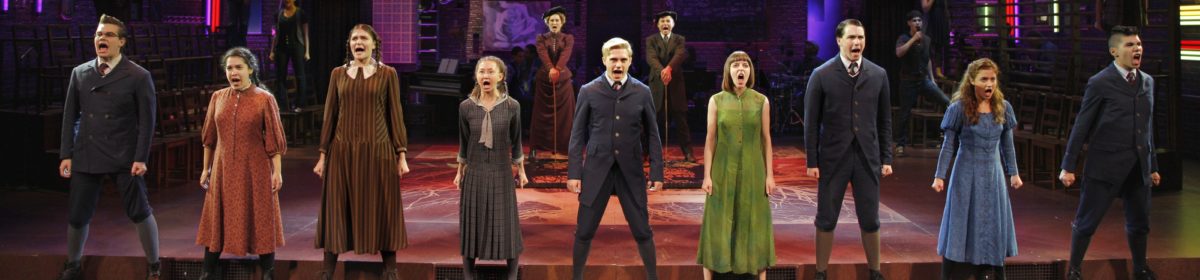
 First came the novel by Roy Horniman, then the classic comedy film: Kind Hearts and Coronets, starring Alec Guinness. Just recently this tongue-in-cheek, hilariously grim story has been adapted to musical theatre by Robert L. Freedman and Steven Lutvak. The result: A Gentleman’s Guide to Love and Murder, is a marvelous spoof of Agatha Christie’s archetypal paradigm of killing off victims one by one, and a cynical, heartless jab at the vapid British aristocracy.
Monty Navarro (Kevin Massey) has just lost his devoted mother, when he is visited by (former nanny?) Miss Shingle, who divulges he is actually an heir to the D’Ysquith fortune, through a previous indiscretion between his mother and a handsome rogue. Only eight other cousins stand between Monty and the staggering sum, and Miss Shingle encourages Monty to pursue this. His initial queries into the matter are met (as you might expect) with arrogance and hostility. Along this twisted odyssey he wrestles with married, life long love, Sibella, and newfound romance with cousin Phoebe. He discovers that while some D’Ysquiths are terribly vile, others, though eccentric, are perfectly charming. He even finds true friendship with one cousin who’s hired him to work at his legal firm. How could poor, conflicted Monty even consider taking this man’s life?
The genius of A Gentleman’s Guide….is chiefly two-fold. First, with songs and sentiments like “I Don’t Understand the Poor” (in the fine tradition of Oscar Wilde’s The Importance of Being Earnest) Freedman and Lutvak positively skewer the privileged class, and any sympathy whatsoever for the D’Ysquiths. Despite digression and mitigation. Ezekiel, a minister and the first cousin Monty meets, assumes he is a “climber” without knowing anything else about him, and says as much. Second, fate conspires to make each murder as easy as the next. As if cosmic justice were simply being handed to Monty with a map. Like Lolita’s Humbert Humbert, just when Monty’s sinister plan seems to be in jeopardy, events intervene to save his proverbial bacon.
You might say that A Gentleman’s Guide… is a grand example of nothing succeeding like excess. John Rapson plays all the D’Ysquiths with dexterity and panache. The content is imbued with wry unbuffered ghoulishness, many of the murders accomplished with cartoonish glee. The subtext is clearly on Monty’s side, with the perverse irony that karma is abetting a charming, admirable serial killer. We don’t wince at say, a decapitation because the victims are all crackpots or despotic. We laugh as we witness this succession of executions, so ridiculously easy they are emptied of all gravitas. My one, trivial criticism of this thoroughly pleasurable musical romp is a kind of backpedaling sop to morality just before the final curtain falls. But don’t let that ruin it for you. I certainly didn’t.
ATTPAC Broadway Series presents A Gentleman’s Guide to Love and Murder, playing August 16th-28th, 2016 at The Winspear Opera House. 2403 Flora Street, Dallas, Texas 75201. 214-880-0202. www.attpac.org
 Strange title for a farce: One Man: Two Guvnors. It’s direct, but it doesn’t feel direct. Resourceful servant Frank (Francis) Henshall is working for two different men without either of them knowing, which keeps him (and us) on our toes. Frank maintains a cozy, ongoing aside with the audience, which feels fresh and spontaneous, along with lively musical interludes by four piece band, “The Quid.” It all has a relaxed, congenial demeanor, which serves the pervasive, deadpan silliness well. One never loses the sense of wonder and enigmatic alchemy that makes a particular comedy fizzy and sublime while others, with similar aims, will crash and burn. How can they all be so wildly divergent?
 Robert O’Hara’s Bootycandy, currently playing at Stage West in Fort Worth, is fierce, dark, satire. Like David Mamet’s Sexual Perversity in Chicago, it has very grim undercurrents, disguised as comedy of manners. Making the trek to cowtown exhausts me, but I wince to think I might have missed one of the most powerful, chilling, sardonic shows I have ever experienced, period. It lulls you with the quaint humor of queer sexuality as it’s perceived in Afro-American culture. Yes (just as in white culture) much of the contempt our hero, Sutter, is exposed to, comes from ignorance. And on its face it’s funny. But the longer and harder and closer you look, the more poisonous it feels. As if Sutter, cool, genuine, sophisticated, is being gradually slipped strychnine. O’Hara satiates us with the candy of hilarity, while delivering his rabbit punches with stealth.
 Theresa Rebeck’s The Novelist is a beguiling and (not unexpectedly?) fairly literary drama. Metaphor overlaps with metaphor, delicate butterflies in shadow boxes, Frank, one son who cannot finish sentences, yet brings statues pregnant with implication, Ethan, the other, cannot tell he is turning into his father. If anything Rebeck spells the subtext out a bit too clearly, but The Novelist is certainly absorbing and wise without ever turning cynical. At least not towards anyone who doesn’t warrant it.
 A somewhat cynical (if good-humored) commentary on the institution of marriage, Company is a sophisticated, sly, subversive musical comedy by Stephen Sondheim (music and lyrics) and George Furth (book) that premiered in 1970 and forever changed the way we think about the genre. With no plot to speak of, and no trackable timeline, it’s more conceptual than narrative, the subject being the predicament of Bobby. We could speculate about the “message.” Perhaps the great quote by Joan Didion, “Anything worth having has it’s price,” or the secret to any mature relationship is compromise, but we have to wonder if the quizzical ending logically follows from what came before, or if it was somehow, fudged. Whatever flaws Company may have, though, are trivial. It continues to be, 46 years later, compelling, breathtaking, sharp and undeniably entertaining. With a subtext lurking like a feisty schnauzer. Many songs have an angry undercurrent, The Ladies Who Lunch is really furious, Barcelona may be one of the saddest songs ever written, and Being Alive is tortured and ambivalent.
 Rarely have I seen a show with such bonejolting, abyss swimming, heart shredding velocity as L.I.P. Service’s Trainspotting at the The Rudy Seppy Studio in Irving. Adapted from Irvine Welsh’s novel by Harry Gibson, it reveals the lives of Mark Renton, et al: disaffected Scottish heroin addicts who kill the pain of despair and seething anger with mindless promiscuity and drug abuse. If not teenagers, they are not much older. This is thwarted eruption and anarchy with maybe the slightest whisper of irony or relief. Sex undercut by the shame of dirty bedsheets is metaphor for Trainspotting: kids who fuck with fierce indifference but worry about ass stains. Mark lives by impulse, but still seems to be the only one amongst his friends (Tommy, Simon, Lizzie, Allison, Franco, and “Mother Superior” a drag nun) not completely numb to their dwindling conscience. When Tommy begs Mark to help him try smack, he really tries to stop him, but Tommy, it seems, is bent on urgent ruin.
 Javier Mejia was brought to America when still a baby, by his mother who was fleeing the atrocities of war. Now he belongs to the marginalized “Dreamers.” Raised as a law-abiding American and contributing member of society, he is caught between the raging politics that refuses to validate him as a bona fide citizen, or deport him as an illegal alien. A policy defined as “deferred action.” Society benefits from his presence, but he is denied the privileges any other valuable American could take for granted. When Javier accidentally finds himself perceived by the Latino community as a symbol, a figurehead for this grievance and cause, he is faced with a crucial decision. Though it may not necessarily be the one we’re expecting, he is overcome by the leverage he wields.

